AT THE BENCH
The useful part, first.
- Current limit lowers output voltage when the load demands more than the setting.
- Stored output energy can reach the load before regulation responds.
- Current injection requires a known rail and board-specific limits.
What constant current means
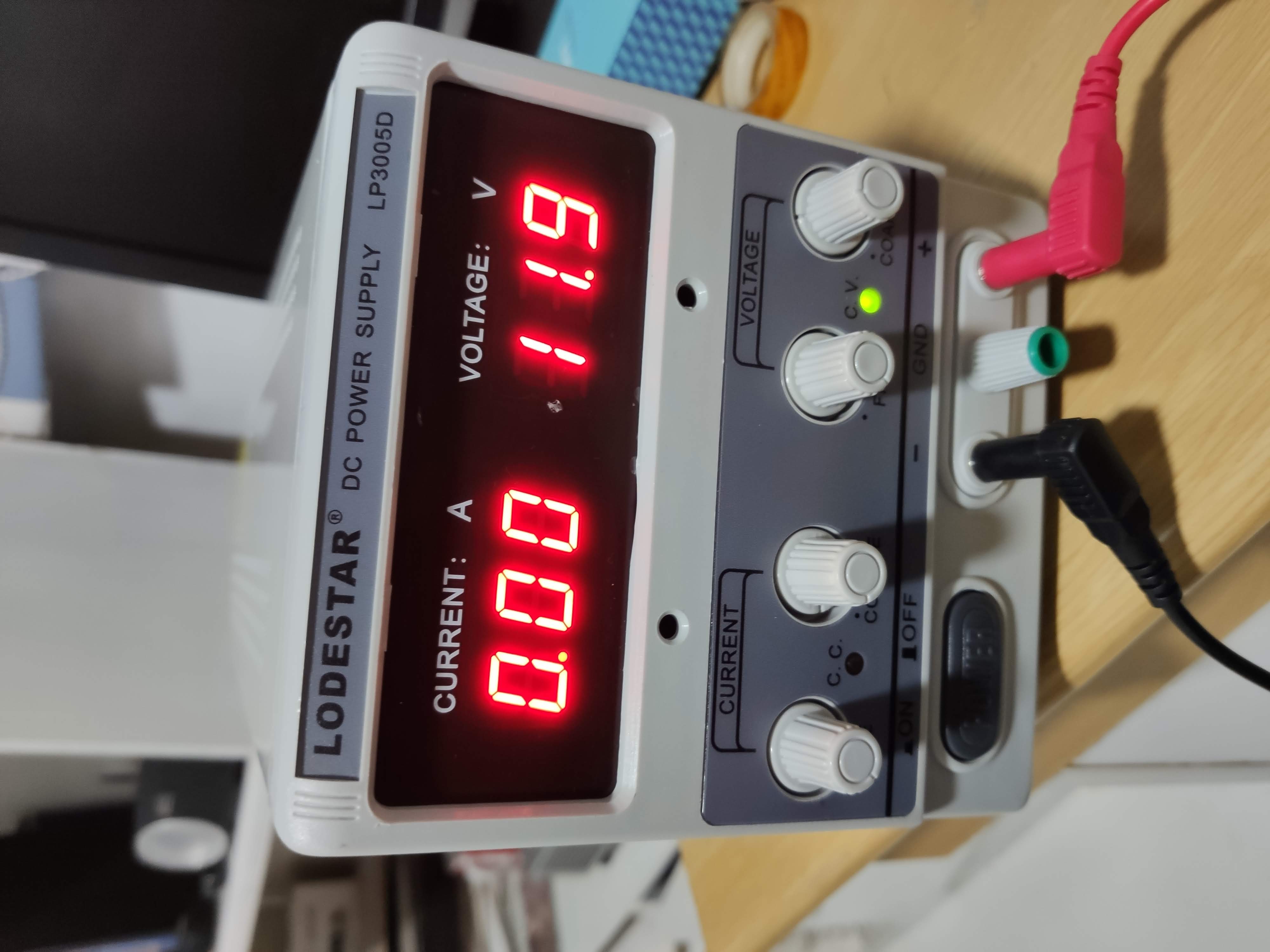
In normal constant-voltage operation, a supply adjusts its output to maintain the chosen voltage. If the load would draw more than the chosen current limit, a conventional constant-current mode reduces the output voltage to hold the current near that limit. The current setting is a ceiling in that operating mode, not an instruction to push the selected current through every load.
Some supplies or modes instead latch off, pulse, or require a reset after overload. Read the documented behaviour and test it on a known load. A lit CC indicator tells you about the supply’s present operating state. It does not explain whether the board is faulty, whether its startup demand is normal, or whether an earlier transient exceeded the current setting.
The first event can differ from the settled state
Output capacitance stores energy. If the output is charged before a load is connected, that energy can be released faster than the regulation loop can correct it. lygte’s DPH3205 review explicitly discusses this issue when connecting an LED. A current-limited supply should not be treated as a universal LED driver or an instantaneous protective barrier for every sensitive component.
Gough’s HMC8043 performance review separates current behaviour from steady voltage accuracy and includes overshoot observations. The useful lesson is the test structure: record how the supply enters and leaves a limit, with a defined load and timing. The results apply to the reviewed setup; they do not establish the behaviour of a different supply sold under a similar rating.
Check it without a repair board
Choose a load rated for the expected voltage, current and dissipation. Set the output with the load disconnected and output disabled, following the manufacturer’s procedure for current adjustment. Connect the test load, enable output and observe the transition. Increase load demand within the equipment ratings to reach current limit, then reduce it and observe recovery. Do not assume that deliberately shorting every supply is an approved procedure.
Record voltage at the terminals and, where relevant, at the load. Lead resistance can account for a meaningful voltage difference at higher current. A meter can establish settled behaviour; an oscilloscope and a suitable current measurement can reveal a transient. Label the difference between these observations instead of describing a meter-only check as a complete protection test.
Applying it to a board
Before powering a board, establish the intended connection, polarity, voltage range and expected startup behaviour. A low limit may prevent a healthy board from starting, while a high limit can allow a fault to dissipate damaging power. Use device-specific documentation and a known-good comparison where available. There is no single phone-board current setting appropriate to every connection.
Fault-finding by current injection requires an identified rail and a known allowable voltage. Disconnect other power sources as required by the board-specific procedure. Do not inject a convenient supply voltage into an unknown node. If a fault does not produce a visible hotspot, that alone does not prove the absence of a short: the power can be small, distributed or hidden from the observation method.
Read the limit alongside the repair log
Write down the limit, actual current, actual voltage and point of connection for every observation. “Drawing 0.2A” is incomplete if the supply has reduced voltage to hold that current. A log that includes mode and timing lets another technician distinguish a stalled startup, a normal transition and a persistent load before changing parts.
THE RECORD
Sources & limitations
Research was gathered on 21 September 2026. These links were not freshly reverified for this edition. A test result is specific to its sample, setup and stated conditions.
- lygte: DPH3205 current and load tests
Original webpage measurements and charged-capacitor warning.
- Gough Lui: HMC8043 performance review
Original webpage evidence, with condition-specific current and voltage behaviour.
- lygte: DPS5020-USB dynamic tests
Load-step, startup and noise observations for the reviewed module.