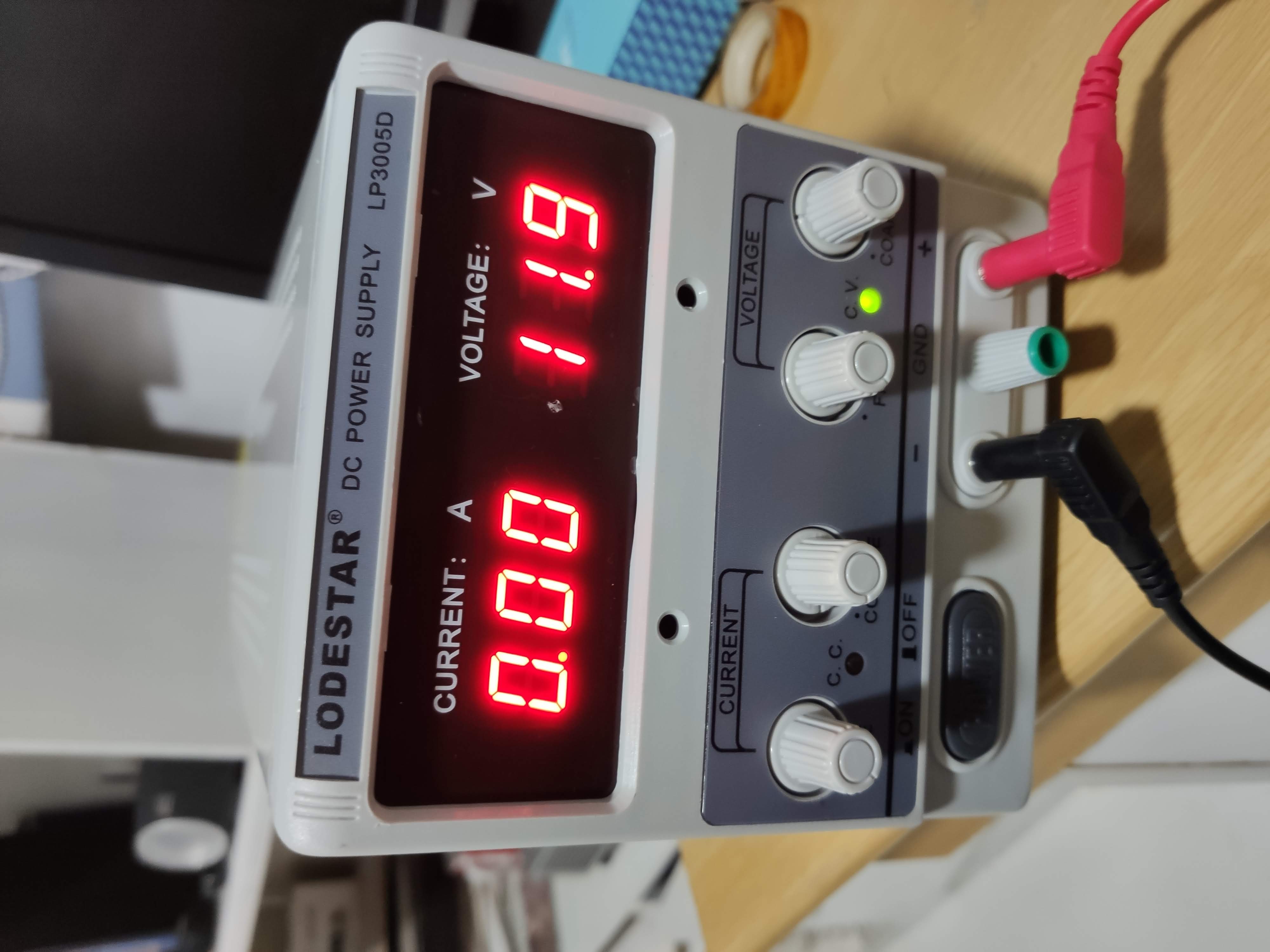
AT THE BENCH
The useful part, first.
- Test output enable, mains startup and shutdown as separate events.
- Use a known test load before attaching a valuable board.
- A no-load result is not automatically a loaded-board result.
A set voltage is a steady-state promise
A supply can settle accurately at its set voltage while behaving differently during output enable or loss of mains power. Control loops need time to establish regulation. Output capacitors retain energy. A connected board has capacitance, protection circuits and changing loads of its own. Those first moments deserve their own test rather than an assumption based on a front-panel display.
Define the event before comparing supplies. Switching on the mains, enabling an already powered output, reconnecting leads and recovering from current limit are different conditions. Record whether voltage and current settings are recalled, whether the output resumes automatically, and whether a separate output button is available. Behaviour after an unexpected interruption can matter as much as the normal start.
Two sources show why conditions matter
Gough Lui’s HMC8043 performance review reports an unexpected mains-off overshoot reaching approximately 4.456V in a no-load test. The article includes load qualifications and manufacturer communication. This is a specific observation of that test arrangement. It is not a claim that all HMC8043 outputs, or all laboratory supplies, expose a connected phone board to that voltage.
lygte’s DPH3205 review records a slow startup and an output that takes roughly five seconds to discharge without a load after shutdown. It also discusses the energy in a charged output capacitor when connecting an LED. These are useful reminders that switching an output off does not necessarily mean the terminals have immediately reached zero volts.
Build a small event matrix
Start with a documented resistive load or an electronic load within the supply’s limits. Observe the output with an appropriately rated oscilloscope connection. Record the probe, bandwidth setting, grounding arrangement, load and cable length. Check the grounding relationship before connecting test equipment; do not assume every supply output and oscilloscope input is isolated.
Capture no-load and loaded output enable, normal shutdown, mains startup and recovery after a deliberate load transition. Use repeatable triggering and retain the full time scale. A tightly cropped waveform can hide slow settling or the event that caused a spike. Repeat each condition and report the spread rather than selecting the neatest trace.
| Event | What to look for |
|---|---|
| Output enable | Peak voltage, ramp and settling |
| Mains startup | Recalled settings and automatic output state |
| Output disable | Residual voltage and discharge time |
| Load transition | Voltage sag, recovery and current-limit entry |
A multimeter has a different job
A multimeter is useful for checking settled voltage, polarity and residual voltage. It usually cannot establish the absence of a short transient. If an oscilloscope is unavailable, describe the checks you did perform and leave startup overshoot unknown. A supply should not receive a “no spikes” badge merely because the display looked stable.
For buying decisions, prefer reviews that show conditions and time scales. lygte’s DPS5020-USB article combines startup, load-step and noise observations rather than relying on the maximum current specification. For a repair bench, that evidence is more relevant than unused programmability. It also shows why a budget module must be judged as a complete assembly with its input source and wiring, not as a board alone.
THE RECORD
Sources & limitations
Research was gathered on 21 September 2026. These links were not freshly reverified for this edition. A test result is specific to its sample, setup and stated conditions.
- Gough Lui: HMC8043 instrument performance
Original webpage waveforms. The 4.456V observation is a specific no-load mains-off test with qualifications.
- lygte: DPH3205 power-supply frontend
Original webpage startup, shutdown and load behaviour.
- lygte: DPS5020-USB frontend
Original webpage measurements. Review sample supplied by RD.